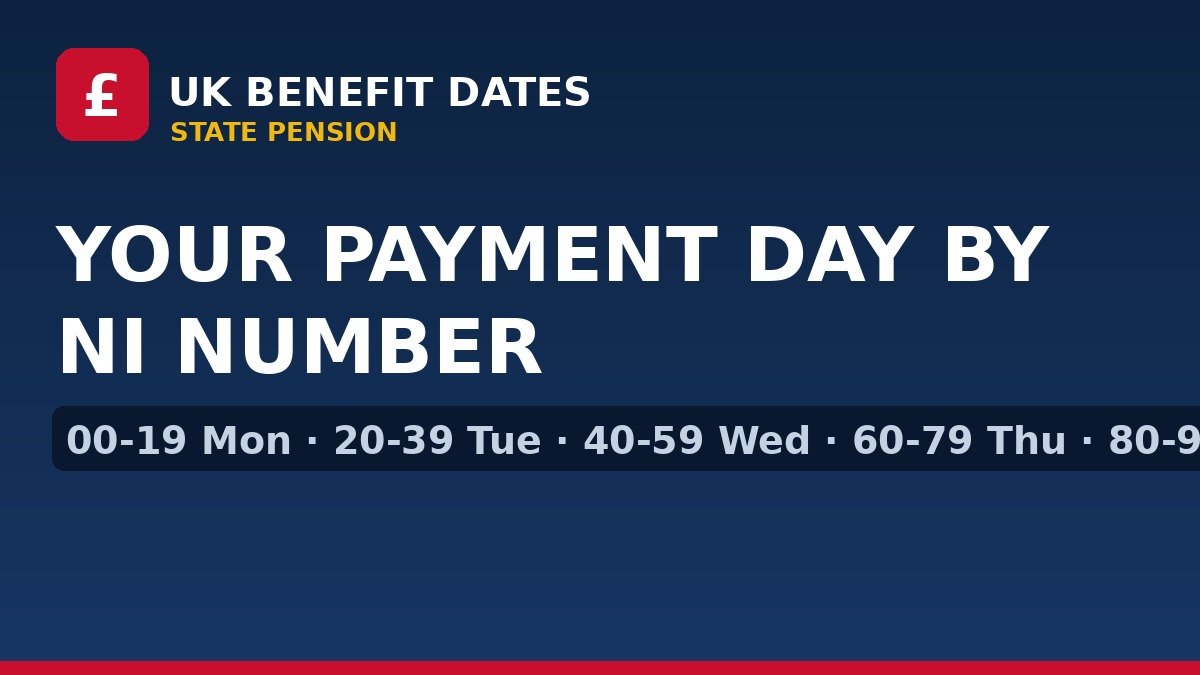
Your State Pension payment day is not random, and it is not the same for everyone. It is fixed by the last two digits of your National Insurance number. Once you know those two digits, you know your weekday — and from there you can work out every payment date for the year ahead, including what happens when a bank holiday gets in the way.
Your State Pension payment day, by NI number
GOV.UK sets the payment day for both the basic State Pension and the new State Pension using the same table. Look at the last two digits of your National Insurance number — the two numbers just before the final letter — and match them here:
| Last two digits of your National Insurance number | Your payment day |
|---|---|
| 00 to 19 | Monday |
| 20 to 39 | Tuesday |
| 40 to 59 | Wednesday |
| 60 to 79 | Thursday |
| 80 to 99 | Friday |
Two quick examples. If your number ends in 45, your State Pension payment day is Wednesday. If it ends in 07, you are a Monday payer. That weekday is yours for as long as you receive the pension — it does not rotate, and it does not depend on when you claimed.
Paid every four weeks, not monthly
The new State Pension is usually paid into your bank, building society or credit union account every four weeks, and the basic State Pension follows the same pattern. Four-weekly is not the same as monthly, and the difference catches people out:
- You receive 13 payments across a year, not 12.
- Your payment date moves through the calendar. A Wednesday payer might be paid on the 4th one month and the 2nd a couple of months later.
- The weekday never changes — only the date of the month does.
Counting forward four weeks from your last payment is the simplest way to find the next one. Our homepage Payment Countdown checker does the counting for you and flags the dates that move for bank holidays.
Your first payment
When you claim, you choose the date you want your State Pension to start. GOV.UK says your first payment will be made no later than five weeks after that date. You might receive part of a payment before your first full one, and the letter confirming your pension tells you what to expect and when. After that first payment, the four-weekly cycle takes over, and your payments settle onto your set weekday.
If you have deferred your pension — chosen to start it later — the same payment day rules apply once payments begin.
What happens when your payment day is a bank holiday
You might be paid earlier if your normal payment day is a bank holiday. In practice, the payment moves to the working day before, exactly as it does for other benefits.
Christmas 2026 shows how it works for two different groups:
- Friday payers (NI endings 80 to 99): a payment due on Friday 25 December, Christmas Day, is paid on Thursday 24 December instead.
- Monday payers (NI endings 00 to 19): a payment due on Monday 28 December — the substitute bank holiday for Boxing Day — is also paid on Thursday 24 December, because the Friday in between is Christmas Day.
Your following payment is not brought forward to match; the four-week cycle continues from your normal pattern. The full Christmas table for every benefit is in our DWP Christmas payment dates 2026 guide.
Checking and changing your payment details
Your payment letter sets out your day and your amounts, and GOV.UK’s State Pension pages let you check how and when you are paid at any time. A few practical points:
- Your payment day itself is fixed. It follows your National Insurance number, so it is not a day you can pick or swap.
- Your account can be changed. If you want your pension paid into a different bank, building society or credit union account, tell the Pension Service, and they will update where the money goes.
- Keep your details current. If your circumstances or contact details change, telling the Pension Service promptly avoids letters and payments going astray.
- If a payment does not arrive, check first whether the date moved for a bank holiday, then check with your bank, and contact the Pension Service if it is still missing.
Frequently asked questions
How do I find my State Pension payment day?
Look at the last two digits of your National Insurance number and use the table in this guide: 00–19 Monday, 20–39 Tuesday, 40–59 Wednesday, 60–79 Thursday, 80–99 Friday. Your pension payment letter also confirms your arrangements.
Is the State Pension paid weekly or monthly?
Neither, as standard. It is usually paid every four weeks, which works out as 13 payments a year. Because the cycle is four-weekly rather than monthly, the calendar date changes through the year, but your weekday stays the same.
Can I change my State Pension payment day?
No — the day is set by your National Insurance number. What you can change is the account your pension is paid into: tell the Pension Service, and they will update your payment details.
What happens if my payment day falls on Christmas Day?
You are paid early, on the working day before. At Christmas 2026, a payment due on Friday 25 December is paid on Thursday 24 December. The same applies at other bank holidays throughout the year, including Easter and the May holidays.
Official source: GOV.UK — New State Pension: when you’re paid