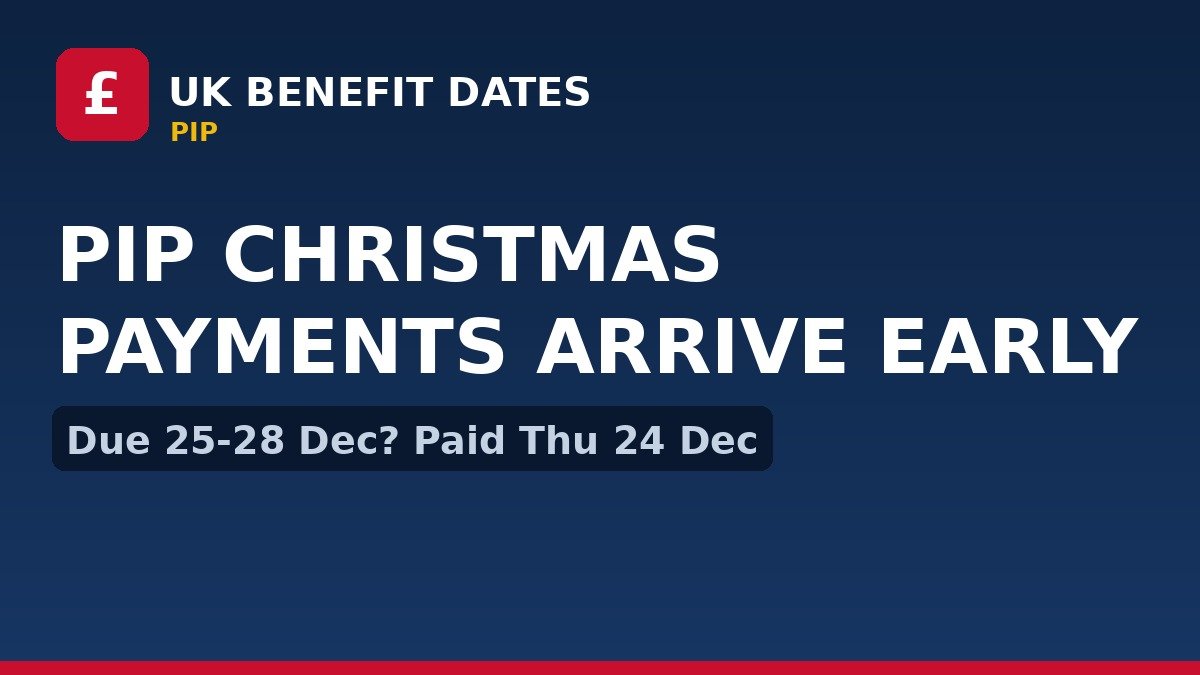
PIP payments due between Friday 25 December and Monday 28 December 2026 will usually arrive early, on Thursday 24 December. That is the direct result of the rule GOV.UK publishes for benefit payments: if your payment date falls on a weekend or a bank holiday, you are usually paid on the working day before. Christmas Day 2026 is a Friday, and the Boxing Day bank holiday falls on Monday 28 December, so the whole four-day stretch is pulled forward to the Thursday before Christmas.
Personal Independence Payment (PIP) is usually paid every four weeks, straight into your bank, building society or credit union account. There is no single national PIP payday. Your payment follows your own four-weekly cycle, so the Christmas shift only changes the payment that would otherwise have landed in that festive window. Every other payment in December follows your normal pattern.
PIP payment dates December 2026 at a glance
| Payment normally due | What happens | Payment date |
|---|---|---|
| Friday 25 December (Christmas Day) | Bank holiday | Thursday 24 December |
| Saturday 26 December | Weekend, followed by a bank holiday Monday | Thursday 24 December |
| Sunday 27 December | Weekend, followed by a bank holiday Monday | Thursday 24 December |
| Monday 28 December (Boxing Day bank holiday) | Substitute bank holiday | Thursday 24 December |
| Tuesday 29 December onwards | Normal working days | Your usual date |
The Saturday and Sunday cases are worth spelling out, because they catch people out. A payment due on Saturday 26 December cannot simply move to Friday 25 December, because that day is itself Christmas Day, a bank holiday. The working day before the whole stretch is therefore Thursday 24 December. The same logic applies to Sunday 27 December. You do not need to contact anyone to make this happen: the early payment is automatic.
Why PIP dates move at Christmas
GOV.UK states the general rule plainly: benefits are usually paid into your account, and if your payment date is on a weekend or a bank holiday you will usually be paid on the working day before. PIP is listed on that same page as usually paid every four weeks. Put those two facts together with the official bank holiday calendar, and the December 2026 picture is fixed: Christmas Day on Friday 25 December, and the Boxing Day substitute bank holiday on Monday 28 December, because Boxing Day itself falls on a Saturday.
New Year 2027: the same rule, one week later
The same pattern repeats at New Year. New Year’s Day 2027 falls on Friday 1 January, so PIP payments due on that Friday will usually arrive on Thursday 31 December 2026 instead. In Scotland there is one extra wrinkle: Monday 4 January 2027 is the substitute bank holiday for 2 January, which falls on a Saturday. A PIP payment due on Monday 4 January in Scotland therefore moves back through two bank holidays to Thursday 31 December as well, because Friday 1 January is itself a holiday.
For claimants in England and Wales, Monday 4 January 2027 is an ordinary working day, so a payment due on that date stays on that date. This is the clearest example of why it pays to check which nation’s bank holiday calendar applies to you, rather than assuming every part of the UK shares the same holidays.
How to work out your own PIP payment date
Because PIP runs on a four-weekly cycle, the simplest check is your own recent pattern. Count forward four weeks from your last payment, and you will usually land on your next payment date. If that date lands on a weekend or a bank holiday, apply the working-day-before rule, working backwards past any consecutive holidays until you reach an ordinary working day. That is exactly how the 25 to 28 December dates all resolve to Thursday 24 December.
What if your PIP payment does not arrive?
Do not panic on the morning of the payment day itself. GOV.UK publishes no exact time of day for benefit payments, and the time money appears can vary by bank. Wait until the end of the payment day before treating a payment as missing. If it still has not arrived, check your bank account carefully, including whether the payment landed under a reference you did not recognise, and then contact DWP through the route given on your award letters. Keep a note of the date you expected the payment and the date you called, so you can explain the gap clearly.
For the full Christmas picture across every benefit, see our DWP Christmas payment dates 2026 table, and if you also receive the State Pension, our State Pension payment day guide explains how that payment day is set from your National Insurance number.
Frequently asked questions
Will my PIP payment really arrive on 24 December?
Usually, yes, if it would otherwise have been due between 25 and 28 December 2026. GOV.UK’s rule is that a payment due on a weekend or bank holiday is usually paid on the working day before, and Thursday 24 December is the working day before that whole festive stretch.
Does an early PIP payment change my next payment date?
No. The early payment is the same four-weekly payment, paid sooner because of the holidays. Your following payment should follow your normal four-weekly pattern, so plan for a slightly longer gap after Christmas.
What happens to PIP payments due on 1 January 2027?
New Year’s Day is a Friday bank holiday, so payments due on Friday 1 January 2027 will usually arrive on Thursday 31 December 2026. In Scotland, payments due on Monday 4 January 2027 also move to Thursday 31 December, because of the substitute holiday for 2 January.
Do I need to claim the early payment or tell DWP?
No. The shift is automatic. You do not need to apply, and you do not need to report that your payment arrived early, unless you believe the amount itself is wrong.
Related posts
 Universal CreditUniversal Credit Payment Late? Check These Steps Before You Call5 Nov 2026
 State PensionState Pension Payments in January 2027: NI-Number Days and the New Year Early Payment5 Nov 2026
 Child BenefitChild Benefit Payments Due 28 December Will Arrive 24 December — and the Northern Ireland Exception5 Nov 2026